
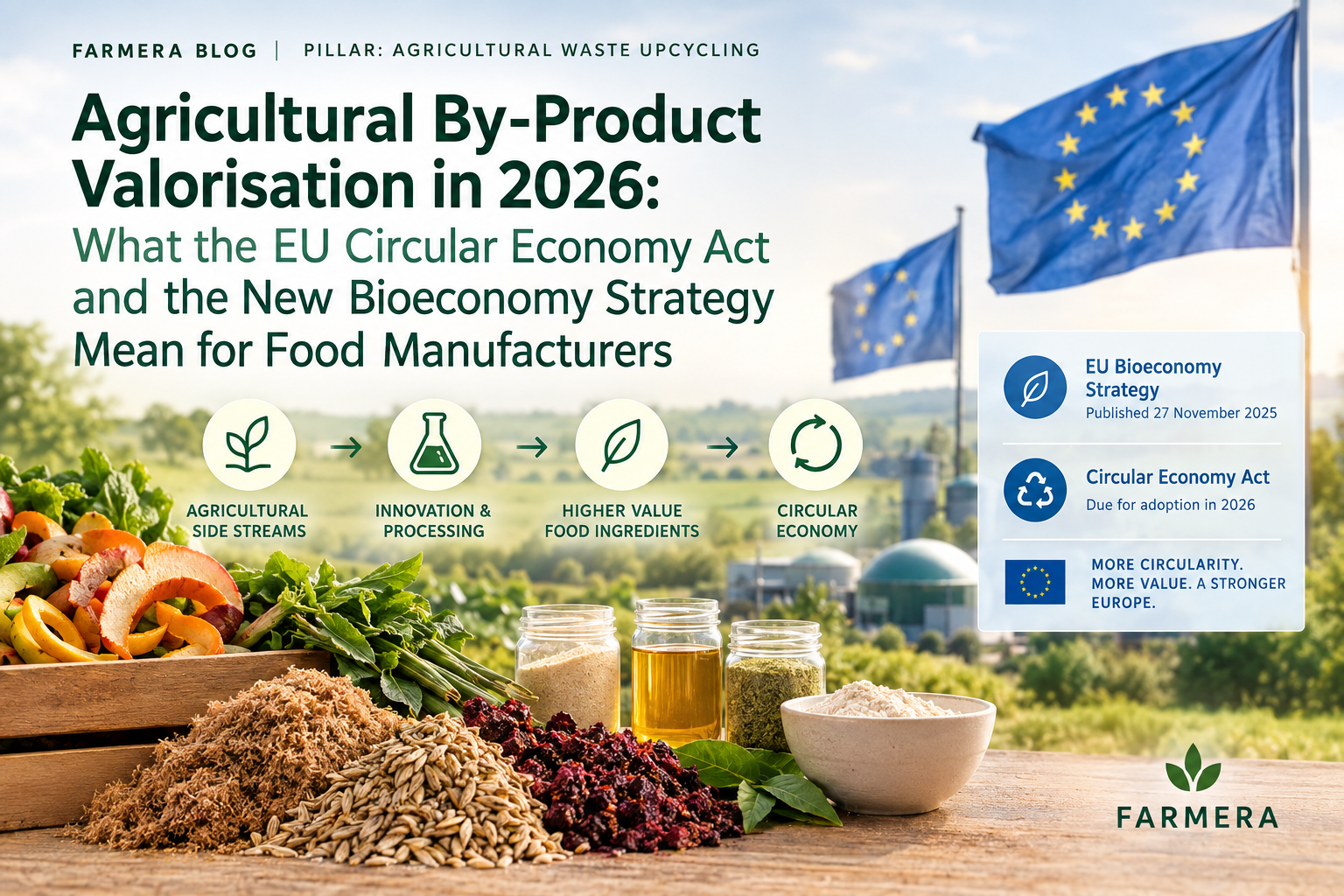
Agricultural By-ProductValorisation in 2026: What the EU Circular Economy Act and the New BioeconomyStrategy Mean for Food Manufacturers
Key takeaways
• The EU published a new Bioeconomy Strategy on 27 November 2025 and has a Circular Economy Act due for adoption in 2026. Together they move agricultural side streams from a waste question to an industrial supply question.
• The EU circular material use rate reached 12.2 percent in 2024, its highest level on record, against a Commission ambition to double circularity to 24 percent by 2030. The gap is the policy pressure.
• Most agricultural and food processing side streams still go to animal feed or energy recovery. Food-grade valorisation captures far more value per tonne, and is where regulation is now pointing.
• The gate is safety and legal status, not chemistry. Contaminants concentrate in side streams, and many by-product ingredients need novel food authorisation before they can be sold in the EU.
• Manufacturers who map, characterise and test their side streams in 2026 will be positioned when the Act lands. Those who wait will be sourcing into a tighter market.
For most of the last decade, the residual streams of food manufacturing have been treated as a cost line. Peels, pomace, pulp, hulls, bran, stalks and press cakes are collected, moved and sold cheaply into animal feed or anaerobic digestion, and the accounting stops there. Two policy developments now make that framing harder to defend, and both are landing inside the same eighteen month window.
The first is the new EU Bioeconomy Strategy, published on 27 November 2025 as "A Strategic Framework for a Competitive and Sustainable EU Bioeconomy". The second is the Circular Economy Act, which the European Commission lists as due for adoption in 2026. Neither is a food waste rule in the narrow sense. Both change the commercial logic of what a food manufacturer should do with the two thirds of a raw material that does not end up in the finished product.
Two policy moves that reprice agricultural side streams
The Bioeconomy Strategy sets the direction
TheCommission is not treating the bioeconomy as an environmental side project. On2023 figures, it puts the EU bioeconomy at up to EUR 2.7 trillion in turnover,generating EUR 863 billion in value added, equivalent to 5 percent of EU GDP,and employing 17.1 million people, around 8 percent of EU jobs. The EU isroughly 90 percent self-sufficient in biomass supply, which makes biologicalfeedstock one of the few strategic inputs Europe does not have to import.
Thestrategy pushes biomass towards higher-value applications and singles outresidual and secondary streams. It commits to a tripartite agreement in 2026 tosupport biogas and biomethane production that valorises bio-waste and residues,promotes circular manure use, and points explicitly to the forthcoming CircularEconomy Act as the instrument for improving bio-waste collection andvalorisation. A Bioeconomy Regulators Forum is scheduled for the first quarterof 2026 and a Biotech Act for the third quarter. The Bio-based Europe Alliance,a coalition of buyers, has committed to purchasing bio-based materials worthEUR 10 billion by 2030.
The Circular Economy Act gives it teeth
TheAct is intended to build a functioning single market for secondary rawmaterials, increasing the supply of high-quality recycled and recoveredmaterial and stimulating demand for it. The Commission frames the ambition inone number: European circularity currently sits at roughly 12 percent, and thegoal is to double it to 24 percent by 2030 as part of the Clean IndustrialDeal.
Thattarget is doing a lot of work, because progress so far has been slow. Eurostatreported on 19 November 2025 that the EU circular material use rate reached12.2 percent in 2024, the highest level yet recorded, but only 0.1 percentagepoints above 2023 and 1.0 percentage point above 2015. The spread betweenmember states is enormous: the Netherlands at 32.7 percent, Belgium at 22.7percent and Italy at 21.6 percent, against Romania at 1.3 percent, Finland andIreland at 2.0 percent and Portugal at 3.0 percent.
Doublinga rate that has moved one percentage point in nine years will requireinstruments that change behaviour rather than report on it. Biological streams,which are large, renewable and domestically available, are an obvious place forthat pressure to land.
Keydates for planning purposes:
Milestone
Timing
EU Bioeconomy Strategy published, COM(2025) 960
27 November 2025
Bioeconomy Regulators Forum convened
Q1 2026
Tripartite agreement on biogas and biomethane from bio-waste and residues
2026
Circular Economy Act proposal due for adoption
2026
EU Biotech Act
Q3 2026
Bio-based Europe Alliance procurement pledge of EUR 10 billion
By 2030
EU circular material use rate doubled to 24 percent
By 2030
Where agricultural side streams actually go today
Thereason valorisation is an opportunity rather than a solved problem is that thedefault destinations are cheap and easy. A detailed Swiss review of food sideproduct streams is instructive because it quantifies what usually staysanecdotal. Swiss food processing generates roughly 1 million tonnes of foodlosses a year, around 0.5 million tonnes on a dry matter basis, of which aboutthree quarters is potentially edible and therefore avoidable.
Thedestinations tell the story. Around 45 percent of whey, some 250,000 tonnes,goes to swine feed. About 63 percent of buttermilk, roughly 60,000 tonnes, goesto livestock. Cereal bran follows the same path: 120,000 tonnes from breadcereals and 60,000 tonnes from durum wheat, fed to animals. And theenvironmental stakes are not marginal. The same work attributes roughly 27percent of the environmental impact of all Swiss food waste, measured fromfield to fork, to losses in food processing alone.
Commercialfood applications remain concentrated in a handful of streams. Wheat bran, ricebran and brewers spent grain are established, mostly as fibre enrichment inbakery and cereal products. For grape pomace, sugar beet pulp, coffee silverskin, rapeseed press cake, cocoa hulls and pulse hulls, commercially availablefood products are scarce or absent, despite volumes that would justifydedicated processing lines.
Thatgap between volume and application is the addressable market. It is also thereason a company that has already characterised its streams will move fasterthan one starting from a spreadsheet.
The real gate is safety and legal status
Twoconstraints explain why so much valorisable material still goes to feed, andneither is solved by better extraction technology.
Thefirst is contaminant carry-over. Side streams are not simply smaller versionsof the parent crop. Peels, hulls and outer layers preferentially accumulatepesticide residues and heavy metals, and grain fractions can carry mycotoxins.Published analysis of cocoa found that up to 56 percent of the cadmium absorbedby the plant concentrates in the shell. Any credible valorisation programmetherefore screens for heavy metals, mycotoxins, pesticide residues andpolycyclic aromatic hydrocarbons against the maximum residue limits set out inRegulation (EC) No 396/2005, batch by batch, across seasons and origins.
Thesecond is novel food status. Under EU rules, an ingredient not consumed to asignificant degree within the EU before 15 May 1997 is a novel food and cannotbe placed on the market without authorisation following an EFSA safetyassessment. A by-product that has spent its entire commercial life in animalfeed frequently meets that definition even though the crop it came from isentirely familiar. The dossier requires precise identity data, including plantpart and geographic origin, full characterisation of the extraction process andsolvents used, compliance with GMP and HACCP, contaminant analysis, and adocumented history of safe use inside or outside the EU.
Thisis a timeline problem more than a scientific one. Authorisation takes time, andthe companies that already hold safety data will be the ones able to supplywhen demand arrives. Coffee cherry pulp and husk, xylo-oligosaccharides fromcorncobs, egg membrane hydrolysate and shrimp peptide concentrate have allcleared the process, which shows the route works when the dossier is complete.
What to do before the Act lands
Thepractical work for 2026 is unglamorous and mostly internal.
1. Map the streams. For each site, list everyresidual stream by volume, seasonality, moisture content and currentdestination, with the price received or gate fee paid. Most manufacturersdiscover they cannot answer this at the level of individual streams.
2. Characterise before you innovate.Compositional analysis, fibre, protein, sugar, pigment and bioactive content,tells you which streams have a food-grade case at all. Volume alone is not anopportunity.
3. Screen for contaminants early. Run the heavymetal, mycotoxin, pesticide and PAH panel at the start, not after a productconcept exists. It is the cheapest way to kill a bad idea.
4. Resolve legal status. Establish whether eachcandidate ingredient is a novel food. If it is, begin building the history ofuse and safety dossier now, because the clock is long.
5. Stabilise the stream. Side streams are wet,seasonal and microbiologically active. Whatever the end application, the firsttechnical problem is almost always holding the material in usable conditionbetween generation and processing.
6. Watch the consultation. The Circular EconomyAct is still being shaped. Sector input during 2026 is the last point at whichdefinitions, and therefore compliance costs, are still movable.
The shift underneath the policy
Theregulatory language talks about waste, circularity and secondary raw materials.The commercial reality is simpler. Europe has a large, renewable, domesticallyavailable biomass supply that it currently converts into its lowest-valueoutputs, and a policy framework that has decided this is a competitivenessproblem rather than only an environmental one.
Forfood manufacturers, the strategic question for 2026 is not whether to comply.It is whether the residual streams currently leaving the site at feed pricesare an obligation to manage or an input to a second product line. The companiesthat answer that early, with data rather than intent, will be the ones settingthe terms when the Act arrives.
Frequently asked questions
What is agricultural by-product valorisation?
Agriculturalby-product valorisation is the practice of converting the residual streams offarming and food processing, things like peels, pomace, pulp, hulls, bran,stalks and press cakes, into products of higher economic and nutritional valuerather than sending them to feed, energy recovery or disposal. In a foodcontext it usually means recovering fibre, protein, pigments, pectin orbioactive compounds and reintroducing them as food ingredients.
Is the EU Circular Economy Act law yet?
No.The European Commission lists the Circular Economy Act as due for adoption in2026, which means a legislative proposal followed by negotiation between theEuropean Parliament and the Council. Companies should treat 2026 as the yearthe direction of travel becomes concrete rather than the year obligationsbegin.
What is the difference between the Bioeconomy Strategy and theCircular Economy Act?
TheBioeconomy Strategy, published on 27 November 2025, is a strategic framework:it sets direction, coordination mechanisms and funding signals for biologicalresources across agriculture, forestry, food and biotechnology. The CircularEconomy Act is intended to be binding legislation focused on secondary rawmaterials and the single market for waste. The strategy explicitly points tothe Act as the vehicle for improving bio-waste collection and valorisation.
Does an upcycled ingredient need novel food authorisation in theEU?
Itdepends on consumption history. Under EU novel food rules, an ingredient thatwas not used for human consumption to a significant degree within the EU before15 May 1997 is a novel food and requires authorisation following an EFSA safetyassessment. A by-product that has always gone to animal feed often falls intothis category even though the parent crop is a familiar food. Coffee cherrypulp and husk, and xylo-oligosaccharides from corncobs, are examples ofby-product derived ingredients that have been through the process.
What are the main food safety risks in side stream valorisation?
Contaminantstend to concentrate in the fractions that become side streams. Peels, hulls andouter layers carry a disproportionate share of pesticide residues and heavymetals, and grain fractions can carry mycotoxins. Published work on cocoahulls, for example, found that a majority of the cadmium absorbed by the plantconcentrates in the shell. Any valorisation programme needs analyticalscreening for heavy metals, mycotoxins, pesticide residues and polycyclicaromatic hydrocarbons, plus a documented, reproducible process.
Which agricultural side streams are already commerciallyestablished as food ingredients?
Wheatbran, rice bran and brewers spent grain have the widest commercial adoption,mostly as fibre enrichment in bakery, cereals and pasta. Streams such as grapepomace, sugar beet pulp, coffee silver skin, rapeseed press cake and pulsehulls have far fewer commercial food applications despite large volumes, whichis precisely where the opportunity sits.
Sources
• European Commission, A Strategic Framework for a Competitive andSustainable EU Bioeconomy, COM(2025) 960, 27 November 2025: https://environment.ec.europa.eu/document/download/dbf8d2ba-9332-4f7a-b336-f356fa4b7236_en
• European Commission, Circular economy strategy page: https://environment.ec.europa.eu/strategy/circular-economy_en
• Eurostat, Over 12% of materials in the EU come from recycling, 19November 2025: https://ec.europa.eu/eurostat/web/products-eurostat-news/w/ddn-20251119-1
• EFSA, Novel foods, food enzymes and food additives derived from foodby-products of plant or animal origin: https://pmc.ncbi.nlm.nih.gov/articles/PMC11165998/
Valorisation potential and challenges of food side product streams for foodapplications, using the example of Switzerland: https://www.sciencedirect.com/science/article/pii/S2666833524000315

