
Carrot Pomace Valorisation in 2026: What the EU's New Carrot Extract Authorisation Means for Food Manufacturers
Every litre of carrot juice leaves a wet, fibrous residue behind. Most of it still goes to animal feed, compost or biogas. In June 2026 the European Union authorised a food ingredient made from that residue, and the decision is a useful reference point for any manufacturer weighing carrot pomace valorisation. This guide explains what was authorised, what the research says about pomace powder in everyday foods, and where the practical hurdles sit.
Key Takeaways
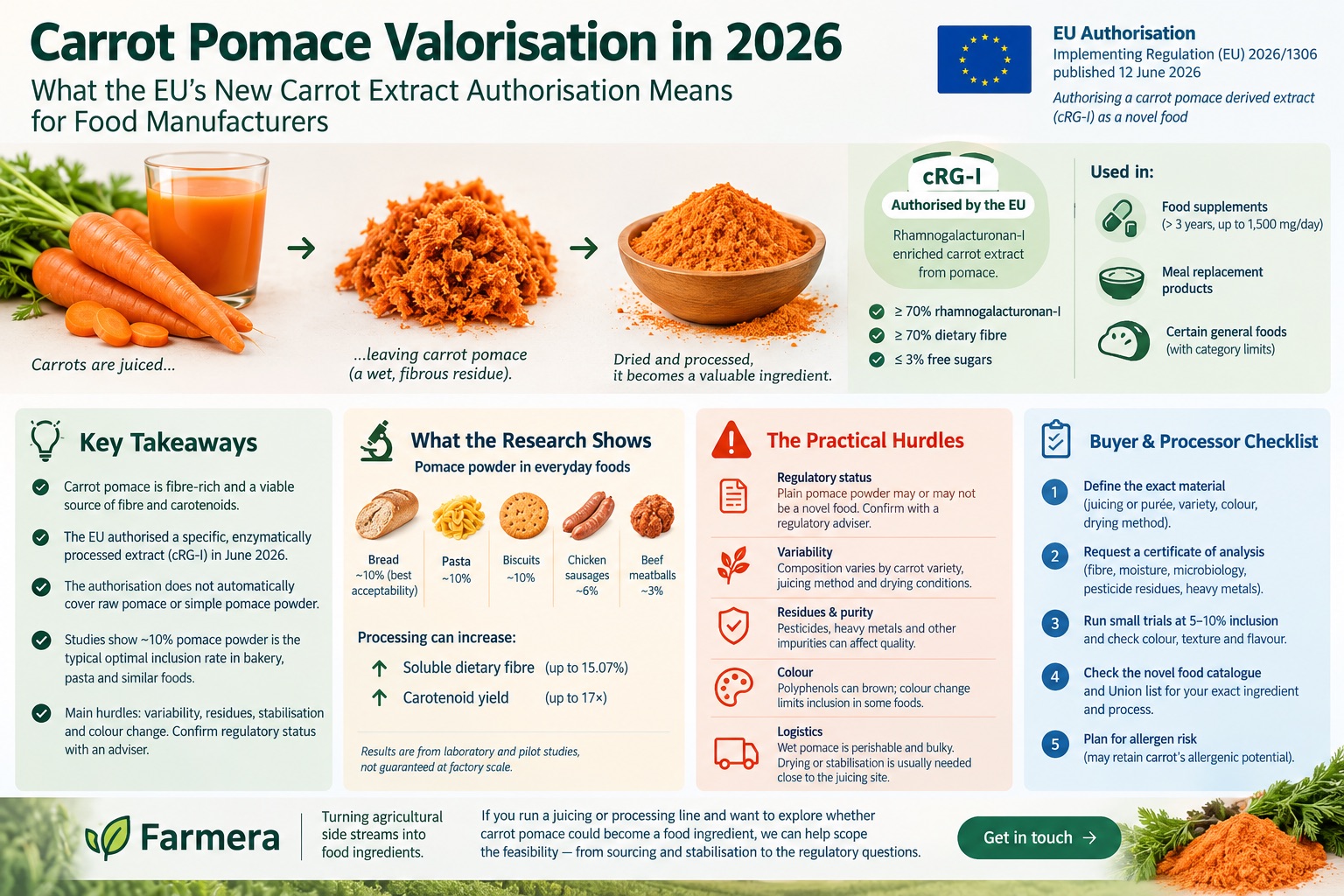
- Carrot pomace is the fibre-rich solid left after juicing. Peer-reviewed reviews describe it as a viable raw material for fibre and carotenoid ingredients.
- On 12 June 2026 the EU published Implementing Regulation (EU) 2026/1306, authorising a carrot pomace derived extract (cRG-I) as a novel food, with specified uses and limits.
- That authorisation covers one specific, enzymatically processed ingredient. It does not automatically cover raw pomace or simple pomace powder.
- A 2026 review in Foods reports that around 10% pomace powder is the typical optimal inclusion rate in bakery, pasta and similar foods, with colour change limiting higher levels.
- Composition variability, residues and stabilisation of a wet material are the main practical barriers. Confirm regulatory status with an adviser before you commit.
What carrot pomace is and why it attracts attention
Pomace is what remains after carrots are pressed for juice or processed into purée. It keeps much of the cell wall material of the root, so it is rich in dietary fibre, along with residual carotenoids and phenolic compounds. A review published in Foods in April 2026 by Căpruciu and Popescu, covering pomace as a food ingredient, reports a dietary fibre content of 43.59% for carrot pomace powder, citing earlier work.
For food manufacturers the appeal is practical. Pomace is already concentrated at juicing sites, it is plant based, and it can be dried into a shelf-stable powder. For growers and processors it is a way to turn a disposal cost into a saleable stream. That fits the wider direction of EU policy on waste. As covered in our earlier posts on EU food waste targets and agricultural by-product valorisation, the Directive (EU) 2025/1892 targets push manufacturers to look hard at their side streams.
The June 2026 EU authorisation: what it actually says
The European Commission adopted Implementing Regulation (EU) 2026/1306 on 11 June 2026 and published it in the Official Journal on 12 June 2026. It authorises rhamnogalacturonan-I enriched carrot extract, known as cRG-I, as a novel food and amends the Union list of novel foods. The applicant was NutriLeads B.V. of the Netherlands. The regulation entered into force on 2 July 2026.
The source material is carrot pomace. According to the regulation, the process uses an enzymatic step that selectively breaks down the pectin fraction, followed by inactivation, purification, heat treatment, drying and pasteurisation. The specification requires at least 70% rhamnogalacturonan-I and at least 70% total dietary fibre, with free sugars of no more than 3%. The regulation names the ingredient an extract rather than a fibre, because the dietary fibre definition in Regulation (EU) No 1169/2011 was not shown to be met.
The European Food Safety Authority had concluded in an opinion published on 29 August 2025 that the ingredient is safe under the proposed conditions of use. The opinion records the applicant's estimate that about 70 kg of pomace is needed per kilogram of finished ingredient. It also notes that no human safety studies on the ingredient itself were available, and that carrot allergy remains a possible concern.
Permitted uses are specific. They include food supplements for people over three years old at up to 1,500 mg a day, and certain meal replacement products, with category limits for some general foods. The regulation also gives the applicant data protection until 2 July 2031, so during that period only NutriLeads may market this authorised ingredient unless another applicant gains authorisation without relying on the protected data or with the company's agreement.
Ingredion announced in August 2026 that its carrot fibre ingredient, Benicaros SF Pure P, can now be sold in the EU following the authorisation, after it completed its acquisition of Benicaros in June 2026. For buyers, the commercial signal is clear: a pomace derived ingredient has cleared the EU novel food route.
Pomace powder in everyday foods: what the research shows
A far simpler route is to dry and mill pomace into a powder and add it to existing recipes. The 2026 Foods review summarises studies across chicken sausages, biscuits, pasta, bread, cookies, gluten-free products and a milk drink. Reported inclusion levels vary by product. Examples cited include 6% in chicken sausages, 10% in biscuits and pasta, and up to 3% in beef meatballs while keeping sensory quality. For bread, the review notes that 10% gave the highest overall acceptability in one study, and that 15% pomace powder raised antioxidant potential by 32% in another.
The review's own summary puts the typical optimal incorporation rate at about 10%. Treat these as research findings from laboratory and pilot formulations, not as guaranteed results at factory scale. Each recipe, process line and customer specification will behave differently.
Processing can also change what the powder offers. The same review reports that combined enzymatic, fine grinding and high pressure treatments raised soluble dietary fibre by up to 15.07% in one study, and that one enzymatic and impact disintegration process raised carotenoid yield 17 fold compared with raw material. These are results from specific studies and depend on the method used.
Hurdles and caveats
Regulatory status is the first question. The cRG-I authorisation is for a defined, enzymatically processed extract with set uses. Whether a plain carrot pomace powder counts as a novel food depends on whether it was consumed to a significant degree in the EU before 15 May 1997 and on how it is made. We have not verified the status of carrot pomace powder as a general ingredient, so please confirm it with a regulatory adviser or the competent authority before launching a product.
Variability is the second. The Foods review states that composition varies widely and that extraction methods are inconsistent. Carrot variety, juicing method and drying conditions all change the result, so a buyer needs a specification and batch testing rather than a general assumption.
Residues and purity are the third. The review notes that pesticide residues and other impurities can reduce the quality of by-products, so a contaminant panel and supplier traceability matter, as they do for any side stream. Colour is the fourth. Polyphenols can brown during processing, and the review says colour change limits how much powder can go into some foods.
Finally, logistics. Wet pomace is a perishable, bulky material. Drying, or a fast route to a stabilised ingredient, usually has to happen close to the juicing site. The cost of that step and a scalable process are open questions the review also flags.
A practical checklist for buyers and processors
- Define the exact material: pomace from juicing or purée, carrot variety, colour, and the drying method.
- Ask for a certificate of analysis covering fibre, moisture, microbiology, pesticide residues and heavy metals.
- Run small trials at 5% to 10% inclusion and check colour, texture and flavour before scaling.
- Check the novel food catalogue and the Union list for your exact ingredient and process.
- Plan for allergen risk. The EFSA opinion on cRG-I notes that it may retain carrot's allergenic potential, with reactions expected to resemble those to carrots.
How Farmera can help
Farmera works on agricultural waste upcycling. If you run a juicing or processing line and want to understand whether a side stream like carrot pomace could become a food ingredient, we can help scope the feasibility, covering sourcing, stabilisation options and the questions to put to a regulatory adviser. Get in touch to start that conversation.
Frequently Asked Questions
What is carrot pomace?
Carrot pomace is the solid residue left after carrots are pressed for juice or processed into purée. It is rich in dietary fibre and contains residual carotenoids and phenolic compounds.
Is carrot pomace powder approved as a food ingredient in the EU?
That depends on its status and production method. The EU has authorised one specific carrot pomace derived extract, cRG-I, through Regulation (EU) 2026/1306. We have not verified the status of plain pomace powder, so confirm with a regulatory adviser.
What is cRG-I?
It is a rhamnogalacturonan-I enriched carrot extract made from carrot pomace by an enzymatic process. The regulation requires at least 70% rhamnogalacturonan-I. It is authorised for listed uses such as food supplements for people over three years old.
How much pomace powder can go into bread or biscuits?
Published studies summarised in a 2026 Foods review test levels from about 5% to 30%. The review reports about 10% as the typical optimal rate, with colour change limiting higher levels.
Why is carrot pomace difficult to use?
Composition varies, wet pomace is perishable, residues need controlling, and pigments can brown. Drying and specification control close to the source are usually needed.
Do the research inclusion levels apply at factory scale?
Not automatically. The studies summarised are mostly laboratory and pilot formulations. Run your own trials on your line, with your pomace, before relying on any figure.
Sources
- Commission Implementing Regulation (EU) 2026/1306 authorising rhamnogalacturonan-I enriched carrot extract (cRG-I) as a novel food, Official Journal, 12 June 2026. https://eur-lex.europa.eu/eli/reg_impl/2026/1306/oj/eng/pdf
- EFSA Journal 2025: Safety of rhamnogalacturonan-I enriched carrot fibre (cRG-I) as a novel food pursuant to Regulation (EU) 2015/2283. https://pmc.ncbi.nlm.nih.gov/articles/PMC12395181
- Căpruciu R., Popescu S.M. Upcycling Apple and Carrot Pomace into Fortified Food Ingredients. Foods 2026, 15(9), 1514. https://www.mdpi.com/2304-8158/15/9/1514
- Food & Drink Technology: Ingredion's carrot fibre wins EU approval, 26 August 2026. https://www.foodanddrinktechnology.com/news/69551/ingredions-carrot-fibre-wins-eu-approval/

