
Date Seed and Pomace Valorisation in 2026: Turning the Date Industry's Largest Side Streams into Food Ingredients
Dates are one of the few crops where the main product is simple and the waste is not. Pit a date and you create a seed. Press it for syrup and you create a fibrous cake. Multiply that across roughly 9.7 million tonnes of annual production and the date industry holds one of the largest, most concentrated fruit side streams in the world. A review published in April 2026 argues these streams are still underused, even as the date market grows. This article looks at what date seeds and pomace contain, where they already work in food, and what a manufacturer should check before putting them in a formulation.
Key Takeaways
- Global date production reached about 9.7 million tonnes in 2024, and the date market was valued at US$31.03 billion, with a forecast of about US$49.14 billion by 2032.
- Seeds make up roughly 10 to 15% of the fruit, and syrup production leaves a pomace cake on top, so one factory generates two distinct side streams.
- Seeds are fibre and lipid rich. Pomace is a fibre source with strong water and oil holding once desugared.
- The main barriers are standardisation, contaminant control, regulatory status and the fact that most evidence is still lab or pilot scale.
A US$31 Billion Crop with a Side-Stream Problem
A review in Molecules published on 3 April 2026 reports global date production of about 9.7 million tonnes in 2024. It values the global dates market at US$31.03 billion in 2024, projects a compound annual growth rate of 5.99% between 2025 and 2032, and puts the 2032 figure near US$49.14 billion. It also notes that the Middle East and Africa account for more than 85% of production. The FAO figure quoted by the International Dates Council in April 2026 is consistent, at about 9.75 million tonnes.
That growth matters for ingredient buyers because side streams scale with the crop. Every additional tonne of dates processed into paste, syrup or powder brings seeds with it and, in the syrup case, pomace. The raw material is concentrated in a handful of producing countries, which makes collection far simpler than for scattered, multi-origin residues.
What the Date Industry Actually Generates
The two side streams behave differently, so it helps to separate them.
Seeds. The seed is the stone removed when dates are pitted. The 2026 review puts it at 10 to 15% of the fruit, while other literature reports figures nearer 18% for pitted dates. Applying 10 to 15% to 9.7 million tonnes implies on the order of one to one and a half million tonnes of seed a year. That is our own back-of-envelope arithmetic, not a reported statistic, and the real figure depends on how much of the crop is pitted and processed rather than sold whole.
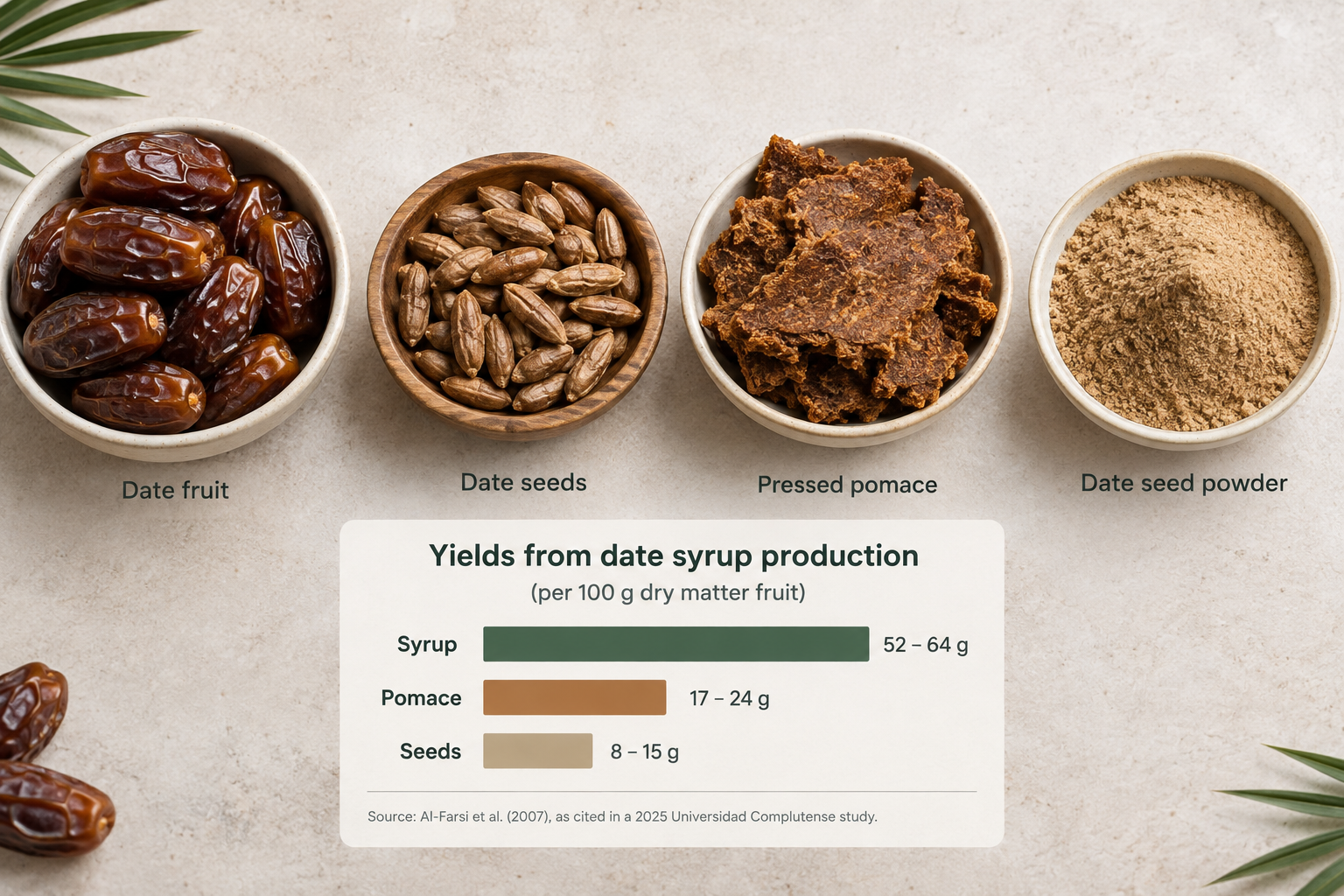
Pomace. Date pomace, also called date press cake, is what remains after syrup (dibs) is extracted. Research on syrup production reports yields of roughly 52 to 64 g of syrup, 17 to 24 g of pomace and 8 to 15 g of seed per 100 g of fruit on a dry matter basis. A separate review gives 17 to 28 g of press cake per 100 g of fruit. In practice, much of this pomace is fed to animals or discarded.
Date Seeds: A Fibre and Lipid Ingredient
Seeds have the stronger compositional case. The 2026 review reports dietary fibre in seeds from 10 to 87 g per 100 g, a wide range that reflects cultivar and method differences, and describes seed fibre concentrates at roughly 50 to 70% fibre. Seed lipids run from 7 to 13%, and seed oil carries tocopherols at 44.7 to 110.8 mg per 100 g, alongside phenolic compounds linked in laboratory studies to antioxidant activity.
Those numbers translate into uses already tested in food. Date seed flour and powder have gone into bakery products, roasted seed has been used as a caffeine free coffee substitute, and seed fibre has been trialled in processed cheese and beef burgers. In one bakery study, date seed powder at 5% addition raised the phenolic content of pita bread and reduced acrylamide formation. Date seed powder is already sold commercially, although it is promoted mainly on nutrient density rather than on standardised specifications.
Date Pomace: A Functional Fibre with a Sugar Caveat
Pomace is closer to a technical ingredient than a flavour one. Characterisation work published in Waste Management in 2023 found higher water and oil holding capacities in dried, desugared pomace. Those are the properties formulators look for in binders and texturisers. The 2026 review also notes the technological potential of date pomace fibre in plant-based meat analogues.
The caveat is sugar. Fresh pomace still carries residual sugars, so it is perishable and its function changes depending on whether it has been desugared and dried. For a manufacturer, the practical specification is the processed pomace, not the raw cake, and the cost of stabilising a wet, seasonal stream has to be counted in.
The Hurdles Buyers Should Weigh
The same review that champions these ingredients is blunt about their limits, and a sensible evaluation starts there.
- Standardisation. Reported compositions vary by cultivar, origin, maturity and analytical method, so published ranges should not be copied into a spec sheet or a nutrition label.
- Contaminants. Lead and cadmium have been detected in some seed samples, and the authors call for explicit contaminant limits and batch monitoring to support regulatory acceptance.
- Regulatory status. The review states that regulatory approval, allergenicity assessment and long term safety evaluation remain inadequately addressed, notably for seed oil. In the EU, an ingredient not consumed to a significant degree before 15 May 1997 needs novel food assessment, a test we cover in our guide to agricultural by-product valorisation in the EU. Whether a specific date seed or pomace ingredient qualifies should be confirmed with a regulatory adviser for the exact product and use.
- Scale. Most studies are laboratory or pilot scale. Few address industrial scalability, cost benefit or long term consumer acceptance, and comparative data on carbon footprint, water and energy remain limited.
- Dosage. Higher inclusion levels can hurt dough rheology, loaf volume, texture and sensory quality, so moderate inclusion tends to perform best.
How to Evaluate a Date Side Stream for Your Formulation
A manufacturer weighing a date seed or pomace ingredient can work through five steps in order. First, define the stream precisely: seed or pomace, which cultivar, and which process step produced it. Second, run a contaminant panel including heavy metals before any sensory work. Third, decide how the stream will be stabilised, since drying, milling and desugaring change both cost and function. Fourth, trial at low inclusion in one matrix, such as bakery or a meat alternative, and measure texture as well as nutrition. Fifth, confirm regulatory status for the intended market and claim before committing to a launch.
This is also where the concentrated nature of the date industry helps. A processor producing seeds and pomace at a single site offers consistency that scattered residues cannot, which makes the first three steps far easier to standardise.
Where This Fits in the Shift to Circular Food Manufacturing
Food manufacturers face growing pressure to cut waste in processing, a point we examined in our piece on the EU food waste reduction targets for 2030, which include a 10% cut for processing and manufacturing. Side streams that already arrive in large, predictable volumes are the natural place to start. Dates are a strong example, and the same logic applies to any crop where one factory step produces a consistent residue.
If you are assessing a date or other plant-based side stream for your products, Farmera works on agricultural waste upcycling and can help you scope what is feasible before you invest in trials. Get in touch to start that conversation.
Frequently Asked Questions
What are the main by-products of date processing?
The two main streams are seeds, removed when dates are pitted, and pomace or press cake, left after syrup extraction. Low grade or damaged dates that never reach the market are a third source.
How much of a date is seed?
The 2026 review gives 10 to 15% of the fruit, while other literature reports figures closer to 18% for pitted dates. The share varies with cultivar and fruit size.
What is date seed powder used for?
Studies have used it in bakery products, as a caffeine free roasted coffee substitute, in beverages, and as a fibre source in dairy and meat products. In one pita bread study, a 5% addition raised phenolic content and reduced acrylamide.
Is date pomace the same as date press cake?
Yes. Both terms describe the fibrous residue left after date syrup, also called dibs, is extracted from the fruit.
Are date seeds approved as a food ingredient in the EU?
There is no one line answer. Novel food rules depend on whether an ingredient was consumed to a significant degree in the EU before 15 May 1997, and the 2026 review notes that regulatory approval is still not well addressed for some seed products. Confirm the status of your exact ingredient and intended use with a regulatory adviser.
What are the biggest risks of using date by-products?
Variability between batches, possible heavy metals such as lead and cadmium in seeds, unclear regulatory status for some forms, and a lack of industrial scale evidence. Each can be managed with specification, testing and staged trials.
Sources
- Djaoudene, O., Rodriguez-Solana, R. and Romano, A. (2026). Valorization of Date Palm (Phoenix dactylifera L.) Fruits and By-Products as High-Value Sustainable Products. Molecules, 31(7), 1194. https://doi.org/10.3390/molecules31071194
- Arab News (13 April 2026). International Dates Council welcomes Libya as official member (FAO production figure). https://www.arabnews.com/node/2639687
- Haris, S. et al. (2023). Characterization analysis of date fruit pomace: An underutilized waste bioresource rich in dietary fiber and phenolic antioxidants. Waste Management, 163, 34 to 42.
- Alqahtani, N. K. (2024). Valorization of the potential use of date press cake (date syrup by-product) in food and non-food applications: a review. Frontiers in Sustainable Food Systems. https://doi.org/10.3389/fsufs.2023.1340727
- Al-Farsi et al. (2007) syrup yield data, as cited in a Universidad Complutense study on downgraded date fruit residues. https://docta.ucm.es/bitstreams/456e4b61-dfd5-4054-9200-f9e09e8a9f8c/download
- Valorization of Date Fruit (Phoenix dactylifera L.) Processing Waste and By-Products: A Review. Applied Sciences, 13(22), 12315. https://www.mdpi.com/2076-3417/13/22/12315

