
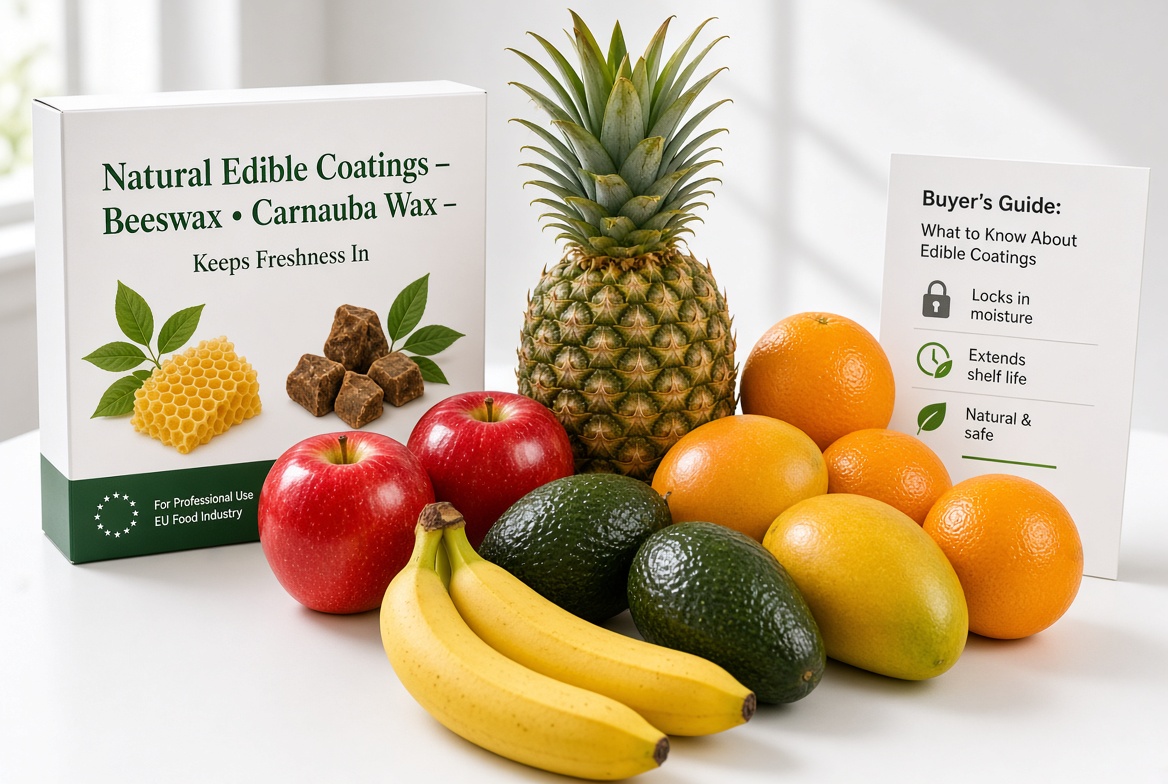
Which Edible Coatings Can Go on Fresh Fruit in the EU? A Buyer's Guide to the Additive Rules
If you grow, pack or buy fresh fruit, a coating that slows moisture loss sounds like an easy win. The harder question is the legal one: can this substance be put on this fruit, for this market? In the EU the answer often sits in food additive law, and the list of permitted coatings is shorter than most buyers expect.
This guide explains how the EU treats coatings on whole fresh fruit, which waxes are listed and for which fruits, and where newer coating chemistries sit relative to that list. It also draws on two recent reviews to show what the research does and does not prove.
Key Takeaways
- In the EU, a coating applied for a technological purpose such as shelf-life extension is generally handled under food additive rules, according to a 2025 review of postharvest edible coatings.
- Regulation (EU) No 1147/2012 added beeswax (E 901), carnauba wax (E 903), shellac (E 904) and microcrystalline wax (E 905) for the surface treatment of named fruits.
- The listed fruits differ by additive, and vegetables are not on that list.
- Newer coatings made from chitosan, proteins or nanocomposites are a separate question. This article has not verified their status, so confirm with a regulatory adviser.
- Promising shelf-life results in the literature come mostly from lab and pilot studies. Treat them as hypotheses to test on your own crop and route.
Why coatings are back on the agenda
Interest in postharvest coatings keeps growing. A mini review in Frontiers in Food Science and Technology, published on 8 July 2026, surveys bio-nanocomposite coatings made from biopolymers such as chitosan and carboxymethyl cellulose, with added nanomaterials. It reports, from earlier studies, that a coating reduced visible fungal deterioration on strawberries by 40 to 60% over 12 days at 7 °C.
Figures like that are reported by individual studies inside a review, not tested guarantees. Crop variety, ripeness, storage temperature and coating thickness all change the result. What the literature does show is a wide set of materials, and that is exactly why the legal position matters before any trial is scaled up.
Is a coating a food additive, an ingredient or packaging?
It depends on the jurisdiction. A 2025 review of edible coatings for fruits and vegetables says coatings may be classed as food additives, food ingredients or packaging materials. For the EU it points to Regulations (EC) No 1331/2008 and 1333/2008 and describes three tests for an additive: no safety risk, no misleading of consumers, and a clear technological need.
That is the reviewers' summary, not the legal text, so read the regulations themselves or ask an adviser before relying on it. The practical point for buyers is simple. If the substance sits on the outside of whole fruit to hold moisture or add gloss, assume the additive rules apply until an adviser tells you otherwise.
What the EU list actually permits
Regulation (EU) No 1147/2012 amended Annex II of the food additives regulation. It was dated 4 December 2012, published on 5 December 2012 and entered into force on 25 December 2012. Under food category 04.1.1, entire fresh fruits and vegetables, it allows four waxes for surface treatment of specific fruits only. As read in the legislation.gov.uk copy of the act, the entries are:
- Beeswax (E 901), quantum satis: citrus fruit, melons, apples, pears, peaches, pineapples, bananas, mangoes, avocados and pomegranates.
- Carnauba wax (E 903), listed with a numeric limit of 200 (check the unit in the regulation): citrus fruit, melons, apples, pears, peaches, pineapples, pomegranates, mangoes, avocados and papayas.
- Shellac (E 904), quantum satis: citrus fruit, melons, apples, pears, peaches, pineapples, pomegranates, mangoes, avocados and papayas.
- Microcrystalline wax (E 905), quantum satis: melons, papayas, mangoes, avocados and pineapples.
Quantum satis means no numeric maximum is set, but the amount used must still be only what is needed for the technological purpose. The recitals explain that these treatments are external and not expected to migrate into the edible part of the fruit. The same act also covers E 901, E 903 and E 904 as glazing agents on nuts.
A caution on currency: this reading comes from the original 2012 act. Annex II has been amended many times since, so check the current consolidated version on EUR-Lex before you commit to a specification.
What falls outside the list
Two gaps stand out. First, vegetables. Recital 8 of the 2012 act says that requests for waxes on other fruits and on vegetables would be considered separately, so a tomato, cucumber or carrot is not covered by the entries above. Second, any coating that is not one of the four listed waxes.
That second group includes the polysaccharide, protein and lipid-resin coatings that dominate current research, and the nanocomposites in the 2026 review. This article has not verified the EU status of chitosan, aloe gel, alginate or any nanocomposite as a surface treatment for fresh produce. Do not assume a coating is permitted because it is edible or natural. Ask for the exact additive entry, the permitted crop and the use level in writing.
What the performance evidence can and cannot tell you
The 2025 review lists a familiar set of trade-offs. Protein coatings tend to be brittle with weak water barriers, lipid coatings have poor mechanical properties, and polysaccharide coatings are hydrophilic. It also names cost, inconsistent application, regulatory hurdles, sourcing of raw materials and scale-up as open problems, and notes incomplete moisture control on high-water produce.
The 2026 review adds that single biopolymers have weak barrier and antimicrobial performance, which is why nanomaterials are being added. It also flags limited long-term toxicity data, no universally accepted legal definition of engineered nanomaterials and a lack of standardised migration testing. It cites EFSA's 2021 guidance on nanomaterial risk assessment as part of the framework. The authors' own regulatory section should itself be checked against primary EFSA and FDA documents.
Hurdles and caveats
Several things can undo a promising trial. A coating that works on a smooth-skinned mango may not behave on a porous or hairy surface. Results at 0 to 4 °C do not transfer to ambient retail conditions. A treatment that is legal in the EU may not be accepted in a destination market, because the review notes that the US, Japan, Canada and Australia and New Zealand each use their own frameworks.
Labelling, retailer standards and organic certification can add further limits that the additive list does not show. Finally, consumer acceptance matters, especially around allergens and perceived naturalness. Build all of these into the trial design rather than discovering them at the end.
Questions to ask before you trial a coating
- Which exact substance and E number is it, and is your target crop named in the Annex II entry for that substance?
- Is the coating applied to the surface only, and what evidence shows it does not migrate into the edible part?
- Which markets will the fruit ship to, and has each market's rules been checked?
- What shelf-life gain was measured, on which variety, at what temperature, and by whom?
- What does the coating do to appearance, taste and wash-off, and how is it applied at line speed?
How Farmera can help
Farmera works on post-harvest shelf-life extension for fresh produce. If you are weighing a coating for a specific crop and route, we can help scope feasibility: what to test, which regulatory questions to put to your adviser first, and how to design a trial that gives a usable answer. This article is general education, not legal advice.
Frequently Asked Questions
Are edible coatings on fresh fruit regulated as food additives in the EU?
Often, yes. A 2025 review says EU coatings applied for a technological purpose fall under the additives framework, citing Regulations 1331/2008 and 1333/2008. Confirm the position for your specific coating with a regulatory adviser.
Which waxes are permitted on fresh fruit in the EU?
Regulation 1147/2012 added beeswax (E 901), carnauba wax (E 903), shellac (E 904) and microcrystalline wax (E 905) for surface treatment of listed fruits. Each additive has its own fruit list, so check the entry for your crop in the current Annex II.
Can I use these waxes on vegetables?
Not under the 2012 entries. Recital 8 says waxes on other fruits and on vegetables would be considered separately. Check the current consolidated Annex II and ask an adviser.
Is chitosan or aloe gel allowed as a fruit coating in the EU?
This article has not verified that. They appear widely in research, but appearing in a study is not the same as having an authorised additive entry. Ask your adviser for the exact legal basis.
Do lab shelf-life results carry over to commercial packing?
Not automatically. The reviews cited here draw mostly on lab and pilot studies, and note scale-up, cost and application consistency as open issues. Run a trial on your own variety, temperature and route.
Where should a buyer start?
Define the crop, market and target shelf-life gain, then ask each supplier for the substance identity, the legal basis and trial data. Farmera can help scope feasibility before you commit.
Sources
- Commission Regulation (EU) No 1147/2012 (legislation.gov.uk copy): https://www.legislation.gov.uk/eur/2012/1147
- Commission Regulation (EU) No 1147/2012, EUR-Lex record: https://eur-lex.europa.eu/eli/reg/2012/1147/oj/eng
- Regulation (EC) No 1333/2008 on food additives, EUR-Lex record: https://eur-lex.europa.eu/eli/reg/2008/1333/oj/eng
- A comprehensive review of edible coatings for postharvest management of fruits and vegetables, Springer (2025): https://link.springer.com/article/10.1007/s44279-025-00348-8
- Bio-nanocomposite edible coatings: a sustainable strategy for postharvest preservation of fresh produce, Frontiers in Food Science and Technology (2026): https://www.frontiersin.org/journals/food-science-and-technology/articles/10.3389/frfst.2026.1838185/full

