
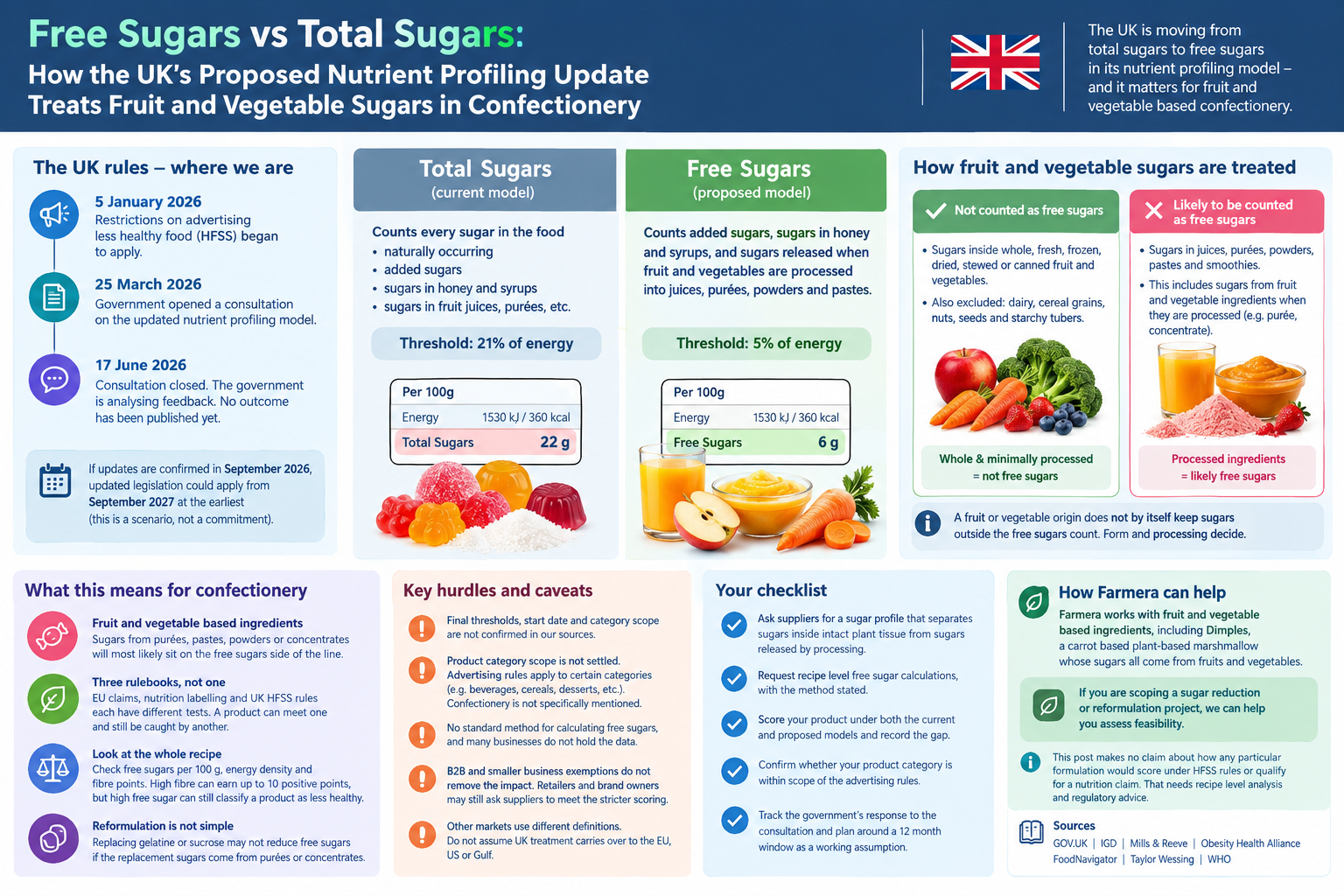
Free Sugars vs Total Sugars: How the UK's Proposed Nutrient Profiling Update Treats Fruit and Vegetable Sugars in Confectionery
On 5 January 2026 the UK's restrictions on advertising less healthy food began to apply. Two months later, on 25 March 2026, the government opened a consultation on which yardstick should decide what counts as less healthy. The headline change is a switch from total sugars to free sugars.
For confectionery makers and ingredient buyers who build products around sugars from fruit and vegetables, the definition of free sugars matters more than the marketing story. This post sets out what has been proposed, how fruit and vegetable sugars are treated, and what to ask your suppliers now.
Key Takeaways
- The UK consultation on applying the updated nutrient profiling model closed on 17 June 2026, and the government is analysing feedback. We did not find a published outcome.
- The proposal replaces total sugars with free sugars and tightens the sugar threshold from 21% of energy to 5% of energy, according to IGD.
- Sugars in juices, purées, powders and pastes are described as free sugars. Sugars within whole fruit and vegetables are not.
- Free sugars cannot be read from a label or measured in a lab, so buyers will need recipe level data from suppliers.
- A fruit or vegetable origin does not by itself keep sugars outside the free sugars count. Form and processing decide.
Where the UK HFSS rules stand
Mandatory restrictions on advertising foods high in fat, salt or sugar (HFSS) took effect on 5 January 2026. Broadcast TV and on-demand services cannot show these ads before the 9pm watershed, and paid online advertising for them is banned. Exemptions include business to business advertising and companies with 250 or fewer employees, according to FoodNavigator. Pure brand advertising is generally outside the ban, but ads showing a specific HFSS product are caught, according to Taylor Wessing.
Whether a product is HFSS is decided by a nutrient profiling model. The current model dates from 2004 and 2005. Foods scoring 4 or more points, and drinks scoring 1 or more, are classed as HFSS. Separate rules on where HFSS products sit in shops and online have applied in England since 1 October 2022.
The government accepted an expert recommendation to update the model, known as the 2018 model. The consultation on applying it to advertising and promotion rules launched on 25 March 2026 and closed on 17 June 2026. Its page says feedback is being analysed.
What changes: from total sugars to free sugars
IGD describes the move from total sugars to free sugars as the most significant change in the updated model. It reports that the sugar threshold would fall from 21% of energy from total sugars to 5% of energy from free sugars. Other proposals include more points for fibre (up to twice as many), scoring salt instead of sodium, and placing seeds alongside fruit, vegetables and nuts.
Timing is conditional. IGD notes that if the government confirmed the updates in September 2026, updated legislation could apply from September 2027 at the earliest. The consultation also asked whether a 12-month implementation period is enough. We have not found a confirmation, so treat those dates as scenarios, not commitments.
How fruit and vegetable sugars are treated
The distinction rests on the form of the ingredient. Law firm Mills & Reeve summarises free sugars as added sugars, sugars in honey and syrups, and sugars in juices, purées, powders, pastes and smoothies. Excluded are sugars naturally present in whole fresh, frozen, dried, stewed or canned fruit and vegetables, along with dairy, cereal grains, nuts, seeds and starchy tubers. The Obesity Health Alliance describes the same line: sugars released when produce is processed count, while those in intact or minimally processed produce do not.
This echoes the WHO definition of free sugars, which also covers sugars naturally present in fruit juices and concentrates. We covered how WHO, US and EU definitions differ in our earlier post on added sugars versus free sugars.
For a confection, the practical reading is that sugars delivered by a processed fruit or vegetable ingredient, such as a purée, paste, powder or concentrate, would most likely sit on the free sugars side of the line. That is our interpretation of the summaries above, not a ruling. The exact boundary for specific ingredients will sit in the final technical guidance, which we have not seen.
What this means for fruit and vegetable based confectionery
Three different rulebooks are in play, and they do not move together. EU claim rules decide whether a pack can say "no added sugars". Nutrition labelling decides what is declared. UK HFSS rules decide whether a product can be advertised to consumers. A product can satisfy one and still be caught by another.
So a sugar story built on fruit and vegetable origin is a positioning choice, not a regulatory shortcut. Buyers who want to reduce HFSS exposure will need to look at the whole recipe: total free sugars per 100 g, energy density, and any points earned from fibre. High fibre foods can earn up to 10 positive points under the proposal, according to the Obesity Health Alliance, but it also notes that a high free sugar content can still classify a product as less healthy. Modelling both the current and the proposed scoring on the same recipe is the only reliable way to see the effect.
For plant-based confectionery such as marshmallow style products, this also changes the reformulation brief. Replacing gelatine or sucrose solves one problem and may leave the free sugar figure largely unchanged if the replacement sugars come from purées or concentrates.
Hurdles and caveats
- The consultation outcome, final thresholds and start date are not confirmed in anything we could verify. Figures above reflect the consultation proposals only.
- Product category scope is not settled in our sources. The advertising rules apply to products in categories listed in regulations. Mills & Reeve names beverages, cereals, cereal bars, yoghurts, desserts, frozen foods and savoury snacks as likely to be affected, and its summary did not mention confectionery. Confirm your own category with a regulatory adviser.
- There is no standard method for calculating free sugars, and many businesses do not hold the data. IGD and Mills & Reeve both flag this.
- The advertising exemptions for B2B and smaller firms do not remove the impact. Retailers and brand owners may still ask suppliers to meet the stricter scoring in their specifications.
- Other markets use different definitions. Do not assume UK treatment carries over to the EU, the US or the Gulf.
A practical checklist for ingredient buyers
- Ask each supplier for a sugar profile that separates sugars inside intact plant tissue from sugars released by processing.
- Request recipe level free sugar calculations, with the method stated.
- Score your product under both the current model and the proposed one, and record the gap.
- Confirm whether your product category is within scope of the advertising rules.
- Track the government's response to the consultation and plan around a 12 month window as a working assumption.
How Farmera can help
Farmera works with fruit and vegetable based ingredients, including Dimples, a carrot based plant-based marshmallow whose sugars all come from fruits and vegetables. If you are scoping a sugar reduction or reformulation project, we can help you assess feasibility. This post makes no claim about how any particular formulation would score under HFSS rules or qualify for a nutrition claim. That needs recipe level analysis and regulatory advice.
FAQ
What is the difference between total sugars and free sugars?
Total sugars counts every sugar in a food. Free sugars counts added sugars plus sugars in honey, syrups and fruit juices, and, in the proposal, sugars released when fruit and vegetables are processed into juices, purées and similar forms. Sugars inside whole fruit and vegetables are left out.
Do sugars from fruit and vegetables count as free sugars?
It depends on the form. Summaries of the proposal say juices, purées, powders and pastes count, while whole fresh, frozen, dried, stewed or canned produce does not. Confirm how your specific ingredient would be classified once final guidance is published.
When could the updated model apply to advertising?
Not before the government responds to the consultation. IGD says that if updates were confirmed in September 2026, legislation could apply from September 2027 at the earliest. We found no confirmation, so plan for scenarios.
Does the HFSS advertising ban apply to business to business marketing?
FoodNavigator lists B2B advertising as exempt, along with companies of 250 or fewer employees. The rules target consumer facing advertising on TV, on demand services and paid online media. Take advice on your own marketing channels.
Does a no added sugars claim mean a product is not HFSS?
No. Claim rules and HFSS scoring are separate systems. A product can meet an EU claim condition and still score as HFSS under the UK model, because scoring looks at the whole nutrient profile.
Does a fibre-rich ingredient help the score?
It can. The proposal gives fibre more weight, and the Obesity Health Alliance says high fibre foods can earn up to 10 positive points. But high free sugar content can still make a product less healthy, so the effect depends on the full recipe.
Sources
- GOV.UK, Applying the new NPM to advertising and promotions restrictions (consultation page): https://www.gov.uk/government/consultations/applying-the-new-npm-to-advertising-and-promotions-restrictions
- IGD, New UK food rules: time to have your say on HFSS: https://www.igd.com/articles/new-uk-food-rules-time-to-have-your-say-on-hfss/73386
- Mills & Reeve, New nutrient profile model implementation, 12 month countdown (27 March 2026): https://www.mills-reeve.com/blogs/food-and-agribusiness/march-2026/new-nutrient-profile-model-implementation-12-month-countdown/
- Obesity Health Alliance, NPM consultation (25 March 2026): https://obesityhealthalliance.org.uk/2026/03/25/npm_consultation/
- FoodNavigator, How regulation will reshape the UK food and drink sector in 2026 (19 January 2026): https://www.foodnavigator.com/Article/2026/01/19/how-regulation-will-reshape-the-uk-food-and-drink-sector-in-2026/
- Taylor Wessing, HFSS promotion, placement and advertising, March 2026 update: https://www.taylorwessing.com/de/insights-and-events/insights/2026/03/aq-hfss-promotion-placement-and-advertising-march-2026-update
- WHO, Guideline: sugars intake for adults and children (2015)

