
Fruit and Vegetable Sugars in Confectionery: How Added Sugars, Free Sugars and No Added Sugars Claims Really Differ
A sweet made with sugars from fruit and vegetables sounds simple to describe. On a label and in a regulator's eyes, it is not. The same ingredient can be 'natural' in a marketing brief, 'free sugars' to the World Health Organization, an 'added sugar' to the US Food and Drug Administration, and a barrier to a 'no added sugars' claim in the European Union. For food manufacturers and ingredient buyers reformulating confectionery, knowing which definition applies is a commercial decision, not a footnote.
This guide compares the three main frameworks, explains where fruit and vegetable sugars land in each, and lists what to check before you build a product story around them.
Key Takeaways
- WHO counts sugars naturally present in honey, syrups, fruit juices and fruit juice concentrates as free sugars, alongside sugars added by manufacturers.
- The FDA's Nutrition Facts guidance treats sugars from concentrated fruit or vegetable juices as added sugars, with specific treatment for juice at 100% juice strength.
- In the EU, a 'no added sugars' claim is barred if any ingredient is used for its sweetening properties, which can include fruit-derived sweeteners.
- Consumers perceive honey, dates and fruit concentrates as natural, but perception is not a legal category.
- Confirm the status of your specific ingredient and market with a regulatory adviser before printing any sugar claim.
Three definitions, one ingredient
Sugar vocabulary changes depending on who is speaking. Public health bodies talk about free sugars. US labelling talks about added sugars. EU claims law talks about added sugars in a narrower, ingredient based sense. These are related but not interchangeable.
WHO: free sugars
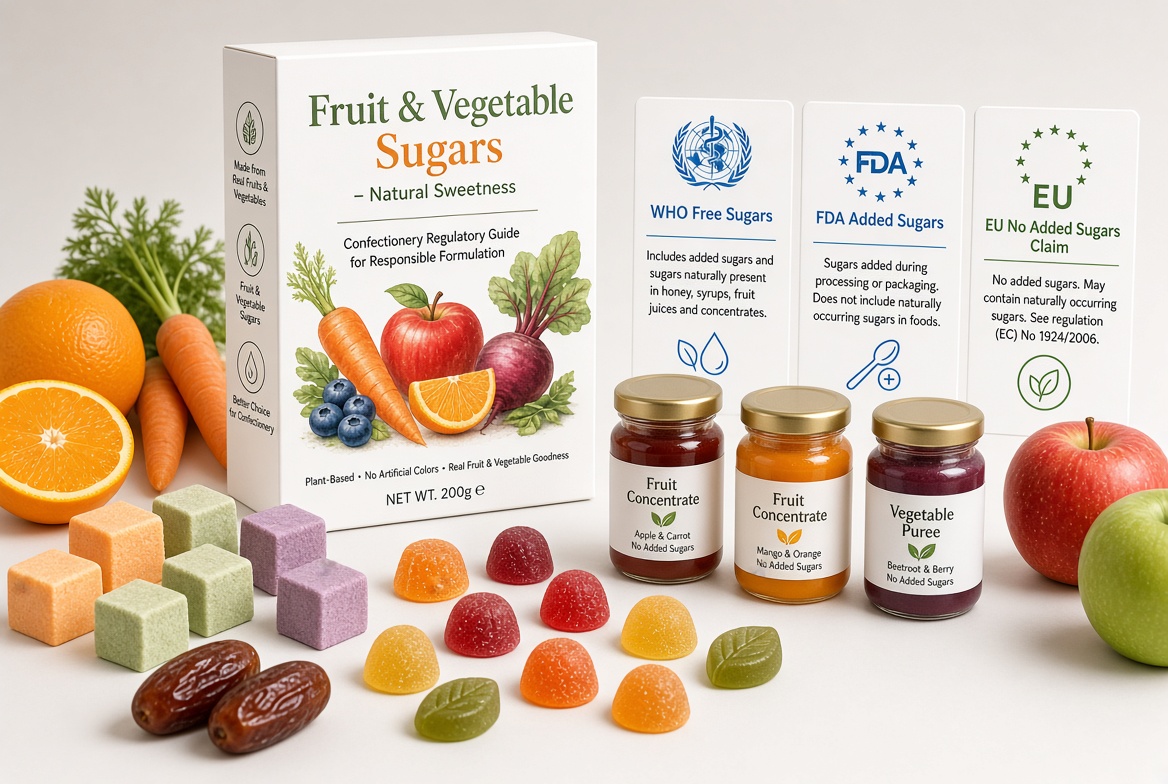
In its March 2015 guideline announcement, the WHO defined free sugars as the simple sugars that manufacturers, cooks or consumers add to foods and drinks, plus sugars naturally present in honey, syrups, fruit juices and fruit juice concentrates. It strongly recommended keeping free sugars below 10% of total energy intake for adults and children, and conditionally suggested going below 5%, roughly 25 g a day, for further benefit.
The practical point for a formulator: a recipe sweetened with fruit juice concentrate or fruit syrup contributes free sugars in the WHO sense, even though the sugars originate in fruit.
FDA: added sugars
In the United States, the Nutrition Facts label must show added sugars beneath total sugars, in the format 'Includes X g Added Sugars'. The FDA's added sugars page, last updated on 4 March 2026, lists sugars from concentrated fruit or vegetable juices among the sources counted as added sugars, next to syrups and honey.
There is a nuance. FDA guidance published in November 2018 said the added sugars declaration should not include juice concentrated from 100% fruit juice when sold directly to consumers. Industry summaries describe the line as whether the concentrate is used beyond what is found in 100% juice. Whether your ingredient, at your use level, falls on one side or the other is a labelling question for a specialist, not a guess.
EU: the 'no added sugars' claim
Under Regulation (EC) No 1924/2006, a 'no added sugars' claim is permitted only if the product contains no added mono or disaccharides and no other food used for its sweetening properties. A fruit based syrup added to sweeten a marshmallow would, on that wording, count as a sweetening ingredient. If the food contains naturally occurring sugars, the label must also carry the indication 'contains naturally occurring sugars'.
A 'low sugars' claim has its own numeric test: no more than 5 g of sugars per 100 g for solid foods. The claims are separate, and meeting one does not satisfy the other.
Why fruit and vegetable sugars are still attractive
Reformulation is hard because sugar does more than sweeten. A ConfectioneryNews review of sweeteners published on 15 September 2026 notes that sugar provides bulk, texture and preservation, so manufacturers often combine sweeteners, fibres and bulking agents. The same article reports that shoppers increasingly check ingredient lists and favour products they see as natural, transparent and minimally processed, and that honey, dates and fruit concentrates attract interest for that reason. It also notes that some natural options cost considerably more than sugar.
That is the commercial case: a whole food origin story for the sweetness, balanced against cost and an honest reading of the rules. Claims such as 'sweetened only with fruit and vegetables' can be accurate and useful, provided they do not imply a regulated status the product does not hold.
Where Dimples fits
Dimples is Farmera's carrot based, plant based marshmallow, and all of its sugars come from fruits and vegetables. For a buyer, the useful question is not whether that sounds natural, but how each target market would classify those sugars. In the WHO framework, sugars from concentrates and syrups would be counted as free sugars. In the EU, a fruit derived sweetening ingredient would affect whether a 'no added sugars' claim is available. In the US, the added sugars declaration depends on how the ingredient is defined and used. We have not verified the regulatory position of any specific Dimples formulation in any market, and nothing here should be read as a claim about it.
Reading the claim from the shopper's side
Shoppers rarely distinguish between free sugars, added sugars and naturally occurring sugars. They read the front of pack and the ingredient list. That gap is where risk sits: a phrase such as 'sweetened with fruit' is easy to say and easy to over read. Keep front of pack wording descriptive of the recipe, and let the nutrition panel carry the numbers.
It also helps to align marketing, regulatory and R&D teams early. Many relabelling costs come from a claim agreed in a brand workshop that was never checked against the ingredient specification. A one page claims matrix per market, signed off before artwork, avoids most of them.
Hurdles and caveats
- Definitions differ by market. A claim that works in one jurisdiction may be unavailable in another, so label strategy should start with the target market list.
- Ingredient specifics matter. Whole fruit puree, juice at single strength, concentrate, and isolated syrup can be treated differently. Specify exactly what you are buying.
- Taste of the claim versus the numbers. A fruit and vegetable sugar story does not change the grams of sugar per portion, which still drive nutrient profiling and sugar content claims.
- Cost and supply. Fruit based sweetening systems can cost more than sucrose and vary by season and origin, so cost the whole formulation.
- Retailer and advertising rules sit on top of labelling law. Check any market specific nutrient profiling that affects shelf placement or promotion.
- Novel food and ingredient status. If an ingredient is new to a market, confirm authorisation status with a regulatory adviser; we have not verified the status of any specific ingredient here.
A buyer's checklist
- Write down the target markets and the exact claims you want to make in each.
- For every sweetening ingredient, record its form (puree, juice, concentrate, syrup) and the Brix or sugar content from the supplier specification.
- Ask your regulatory adviser to classify each ingredient under the relevant added sugars or free sugars definition.
- Model grams of sugar per 100 g and per portion, then test against any 'low sugars' or nutrient profiling thresholds.
- Pilot the texture, since replacing sucrose changes bulk, water activity and mouthfeel.
Next step
If you are exploring a confectionery concept sweetened from fruit and vegetable sources, Farmera can help you scope technical and regulatory feasibility for your target markets. Related reading: our guides to EU food waste targets and to by-product valorisation cover other ways ingredient sourcing is changing under EU policy.
Frequently Asked Questions
Are sugars from fruit juice concentrate counted as free sugars?
Yes. The WHO definition includes sugars naturally present in honey, syrups, fruit juices and fruit juice concentrates, in addition to sugars added during manufacture or cooking.
What is the difference between added sugars and free sugars?
Free sugars is a public health term from the WHO that also covers sugars in juices, syrups and concentrates. Added sugars is the term used on US Nutrition Facts labels, where the FDA lists sugars from concentrated fruit or vegetable juices among the sources it counts.
Can a product made with fruit based sweeteners say 'no added sugars' in the EU?
Only if no added mono or disaccharides and no other food is used for its sweetening properties. A fruit based ingredient added to sweeten would normally be a barrier, so check the exact ingredient and claim wording with a regulatory adviser.
What does 'contains naturally occurring sugars' mean?
Under EU claims rules, a food carrying a 'no added sugars' claim that naturally contains sugars must state that on the label. It applies where sugars come from the food itself, not from an ingredient added to sweeten.
What is the EU threshold for a 'low sugars' claim?
For solid foods, no more than 5 g of sugars per 100 g, and for liquids, no more than 2.5 g per 100 ml, under Regulation (EC) No 1924/2006.
Does Dimples carry a 'no added sugars' or 'low sugar' claim?
We have not verified the claim position of any Dimples formulation in any market. All of its sugars come from fruits and vegetables, but whether a specific claim is available depends on the final recipe and the market, so confirm with a regulatory adviser.
Sources
- WHO, WHO calls on countries to reduce sugars intake among adults and children (4 March 2015): https://www.who.int/news/item/04-03-2015-who-calls-on-countries-to-reduce-sugars-intake-among-adults-and-children
- US FDA, Added Sugars on the Nutrition Facts Label (updated 4 March 2026): https://www.fda.gov/food/nutrition-facts-label/added-sugars-nutrition-facts-label
- US FDA, FDA Brief: new guidances to help manufacturers implement updated Nutrition Facts (2 November 2018): https://www.fda.gov/news-events/fda-brief/fda-brief-fda-issues-new-guidances-help-manufacturers-continue-implementing-updated-nutrition-facts
- AURI, FDA Added Sugars one pager (January 2026): https://auri.org/wp-content/uploads/2026/01/AURI-Food-OnePager-FDAAddedSugars-012626-FINAL.pdf
- Regulation (EC) No 1924/2006 on nutrition and health claims, EUR-Lex: https://eur-lex.europa.eu/legal-content/EN/TXT/HTML/?uri=CELEX:32006R1924
- ConfectioneryNews, From aspartame to allulose: the future of sweeteners takes shape (15 September 2026): https://www.confectionerynews.com/Article/2026/09/15/from-aspartame-to-allulose-the-future-of-sweeteners-takes-shape/

