
Fruit and Vegetable Sugars in Confectionery: What Manufacturers Can Claim in 2026
Confectionery has always been a sugar business. Sucrose and glucose syrup do far more than sweeten: they build volume, set texture, control water activity and keep products stable on the shelf. So when brands look for refined sugar alternatives in confectionery, the first instinct is often to reach for fruit. Fruit concentrates and vegetable purées bring sweetness, colour and a story consumers already trust.
The story is real, but it comes with rules. Regulators in the EU and UK draw a sharp line between sugars that sit inside whole fruit and vegetables and sugars that have been released through juicing, concentrating or puréeing. Get that line wrong and a reformulation project can end with a pack claim you are not allowed to make. This guide explains where fruit and vegetable sugars genuinely help, where they do not, and what to check before you start.
Why refined sugar is under pressure in confectionery
The public health baseline is the World Health Organization's 2015 guideline on sugars. WHO strongly recommends keeping free sugars below 10% of total energy intake, and conditionally recommends going further, to below 5%. National programmes, retailer targets and reformulation commitments across Europe trace back to these numbers.
In the UK, that pressure is now written into law. Restrictions on where less healthy products can be placed in stores and online came into force in England in October 2022, and limits on volume price promotions followed in October 2025. Since 5 January 2026, products classed as high in fat, sugar or salt (HFSS) can no longer be advertised on TV before 9pm, and paid online advertising for them is banned.
Classification still runs on the 2004/5 Nutrient Profiling Model, which scores total sugars. But in January 2026 the Department of Health and Social Care published technical guidance on the updated 2018 model and opened a consultation on applying it. One of the most significant proposed changes is replacing total sugars with free sugars. For anyone planning to swap refined sugar for fruit, that one word matters more than any other.
Free sugars and naturally occurring sugars: the definition that decides everything
In the UK, free sugars follow the definition developed from the Scientific Advisory Committee on Nutrition's 2015 report. It covers all added sugars in any form, plus the sugars naturally present in fruit and vegetable juices, purées, pastes and similar products where the cell structure has been broken down. Juice concentrates, syrups, honey and nectars are all inside the definition.
Two details are easy to miss. First, SACN found no scientific basis for treating vegetable sugars differently from fruit sugars, so a carrot purée counts exactly like an apple purée. Second, the sugars inside intact fruit and vegetables do not count as free sugars. The NHS puts it simply: fruit sugar is not considered free sugar unless the fruit is juiced or puréed.
The EU's Knowledge for Policy gateway uses the same logic, describing free sugars as added sugars plus the sugars naturally present in honey, syrups, fruit juices and fruit juice concentrates. The practical consequence is blunt. A confection sweetened with apple or pear concentrate is, nutritionally, a confection containing free sugars. Changing the source of the sugar does not, on its own, change how a nutrient profiling model or a nutritionist will count it.
What you can and cannot put on the pack
Sugar claims in the EU are governed by Regulation (EC) No 1924/2006. A "with no added sugars" claim is only permitted where the product contains no added mono or disaccharides and no other food used for its sweetening properties. Where sugars occur naturally, the label must also state that the product contains naturally occurring sugars. A "sugars free" claim requires no more than 0.5 g of sugars per 100 g or 100 ml. Great Britain retained the same conditions in its nutrition and health claims register.
Concentrated fruit juice is the textbook example of a food used for its sweetening properties. The UK Advertising Standards Authority made this concrete when it ruled against a drinks brand claiming "0g added sugar". The ASA treated the phrase as equivalent to "no added sugars" and concluded that the grape and apple concentrate in the drink had a sweetening effect, so the claim failed. UK guidance confirms the test is applied case by case, looking at the product, why each ingredient is used and how the product is named.
For confectionery the conclusion is almost always the same: if fruit or vegetable concentrate is there to sweeten, "no added sugar" is off the table. Factual ingredient statements are a different matter from nutrition claims, but any wording a consumer would read as meaning "no added sugar" is caught by the same rules. Have regulatory counsel review the exact phrasing before artwork is signed off.
Where fruit and vegetable sugars genuinely win
None of this means fruit and vegetable sweetening is a dead end. It means the value sits in different places from the ones marketers usually reach for first.
A cleaner ingredient list
A recipe that replaces white sugar and glucose syrup with fruit and vegetable sources reads very differently on the back of pack. For brands chasing clean label positioning, that ingredient list is a legitimate differentiator, provided it is presented as a statement of origin rather than a nutrition claim.
More of the plant, not just its sugar
Concentrates and purées can bring fibre, flavour, colour and minor plant compounds that refined sucrose does not carry. In some systems that fibre also contributes to structure, which opens room to rebalance the rest of the formula.
A sweetener with a supply chain story
Fruit and vegetable sugars connect a confection back to agriculture. For brands with sourcing or sustainability narratives, that link is more credible than a highly processed sweetener system, which UK regulators have already said cannot easily be described as natural. It also fits the wider shift towards getting more value from every crop, covered in our guide to agricultural by-product valorisation.
Formulation realities
Fruit sugars are not a drop in replacement. Apple and pear concentrates are rich in fructose, which behaves differently from sucrose: it is sweeter, attracts more water and browns more readily. In aerated and gelled products such as marshmallow, that changes whipping, setting, stickiness and shelf life. Expect to rebuild the recipe rather than substitute one line.
Marshmallow as a test case: how Dimples approaches it
Marshmallow is one of the hardest categories to move away from refined sugar, because a conventional marshmallow is almost entirely a sugar syrup whipped into a foam and set. That is exactly why Farmera chose it.
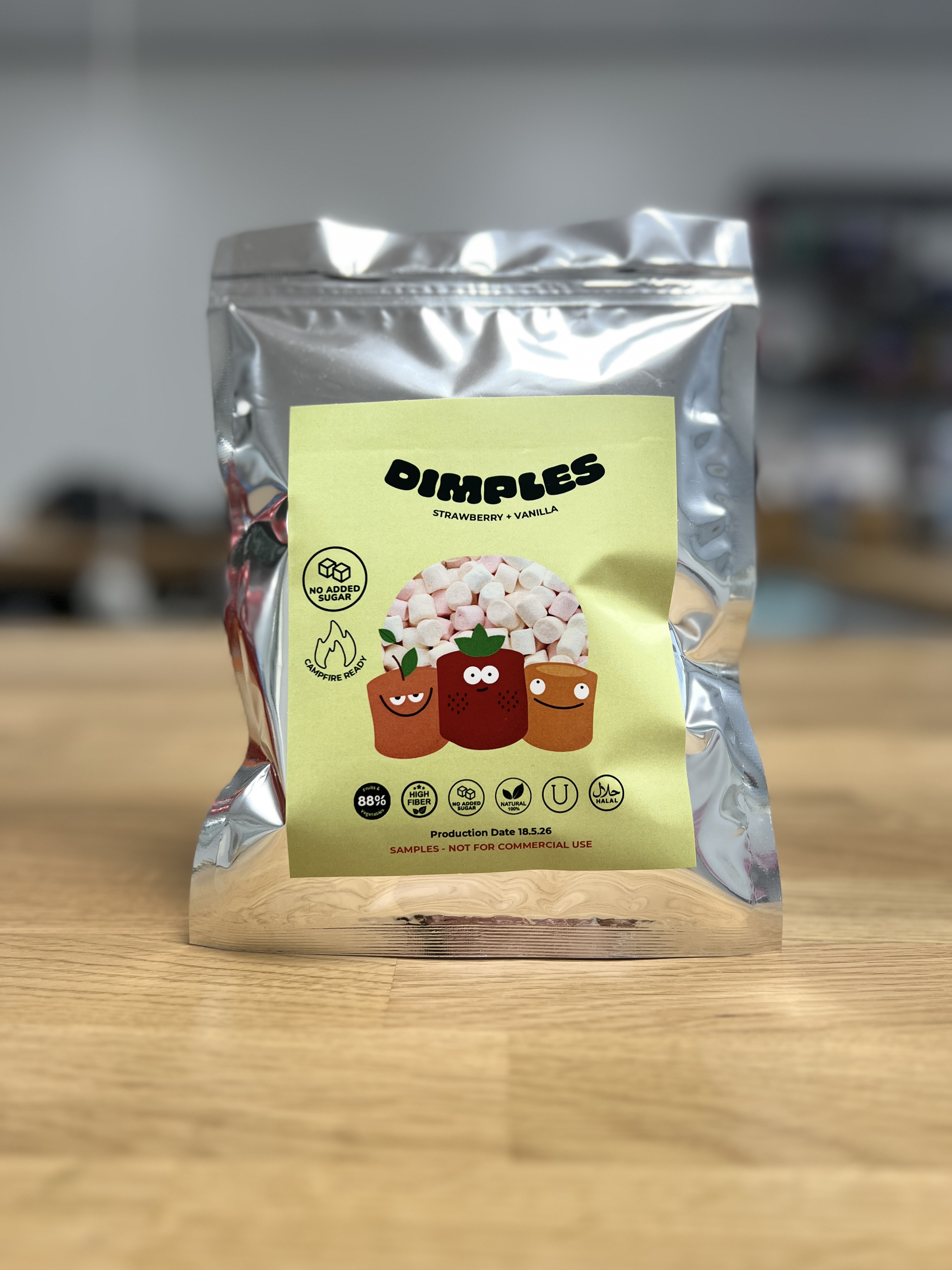
Dimples is Farmera's marshmallow technology in which 100% of the sugars come from fruits and vegetables. Fibre from the same plant sources contributes to the texture, so the structure does not depend on refined sugar. Flavour variants are built on the same fruit and vegetable base.
Farmera does not make or sell marshmallows. Dimples is licensed to confectionery manufacturers, and Farmera connects partners directly with qualified raw material suppliers. In line with everything above, Dimples is positioned on the origin of its sugars and its ingredient list, not on a "no added sugar" claim.
A checklist before you reformulate
- Define the goal. Is it a cleaner ingredient list, lower total sugars, HFSS compliance or all three? Fruit sweetening alone mainly delivers the first.
- Model both nutrient profiles. Score the recipe under the 2004/5 model and the proposed 2018 free sugars approach, so a future switch does not catch you out.
- Map every claim. List each phrase planned for pack and advertising and test it against Regulation 1924/2006 and the GB register.
- Budget for formulation work. Plan pilot runs for aeration, setting, water activity and shelf life, not a single bench trial.
- Secure the supply. Concentrate specification, seasonality and origin consistency drive both quality and cost.
Key takeaways
- Sugars from fruit and vegetable juices, concentrates, purées and pastes count as free sugars under UK and WHO definitions. Sugars inside intact produce do not.
- Vegetable sugars are treated exactly like fruit sugars.
- If a concentrate is used to sweeten, an EU or GB "no added sugars" claim is not permitted.
- UK HFSS advertising restrictions have applied since 5 January 2026, and the proposed 2018 nutrient profiling model would score free sugars rather than total sugars.
- The real wins are a cleaner ingredient list, more of the plant in the product and a credible sourcing story, backed by proper formulation work.
Frequently asked questions
Are sugars from fruit concentrate healthier than refined sugar?
Nutritionally, the sugars in fruit and vegetable concentrates count as free sugars, the same category as table sugar. The difference lies in what else comes with them, such as fibre, flavour and colour, and in how the ingredient list reads.
Can I say "no added sugar" if I only use fruit juice concentrate?
Generally no. Under Regulation (EC) No 1924/2006 the claim requires that no food used for its sweetening properties is added, and concentrated fruit juice is a standard example of exactly that. The ASA has upheld this in the UK.
Do vegetable sugars count differently from fruit sugars?
No. SACN found no scientific basis for treating them differently, so sugars in vegetable purées, pastes and powders count as free sugars too.
Will fruit sweetening help a product pass the HFSS test?
Not by itself. The current 2004/5 model scores total sugars and the proposed 2018 model scores free sugars, and fruit concentrate sugars count under both. Reducing the overall sugar load is what moves the score.
What is the difference between "sugar free" and "no added sugars"?
"Sugars free" means no more than 0.5 g of sugars per 100 g or 100 ml. "No added sugars" means nothing was added to sweeten, though the product may still contain naturally occurring sugars and must say so.
Can marshmallows be made without refined sugar?
Yes, but it takes reformulation rather than substitution, because sugar provides most of a marshmallow's structure. Dimples, Farmera's licensed technology, sources 100% of its sugars from fruits and vegetables and uses plant fibre to support texture.
Interested in licensing Dimples for your production line? Get in touch with the Farmera team.
Sources
- WHO (2015), Guideline: Sugars intake for adults and children
- Swan et al., A definition of free sugars for the UK, Public Health Nutrition: https://www.ncbi.nlm.nih.gov/pmc/articles/PMC5962881/
- NHS, Sugar: the facts: https://www.nhs.uk/live-well/eat-well/food-types/how-does-sugar-in-our-diet-affect-our-health/
- European Commission Knowledge4Policy, Sugars and Sweeteners: https://knowledge4policy.ec.europa.eu/health-promotion-knowledge-gateway/sugars-sweeteners_en
- Regulation (EC) No 1924/2006, Annex: nutrition claims
- ASA, Keeping the regulator sweet: https://www.asa.org.uk/news/keeping-the-regulator-sweet.html
- Food and Drink Federation, HFSS toolkit: https://www.fdf.org.uk/fdf/resources/toolkits/diet-and-health/hfss-toolkit/
- Campden BRI, HFSS legislation: https://www.campdenbri.co.uk/blogs/hfss-legislation.php

